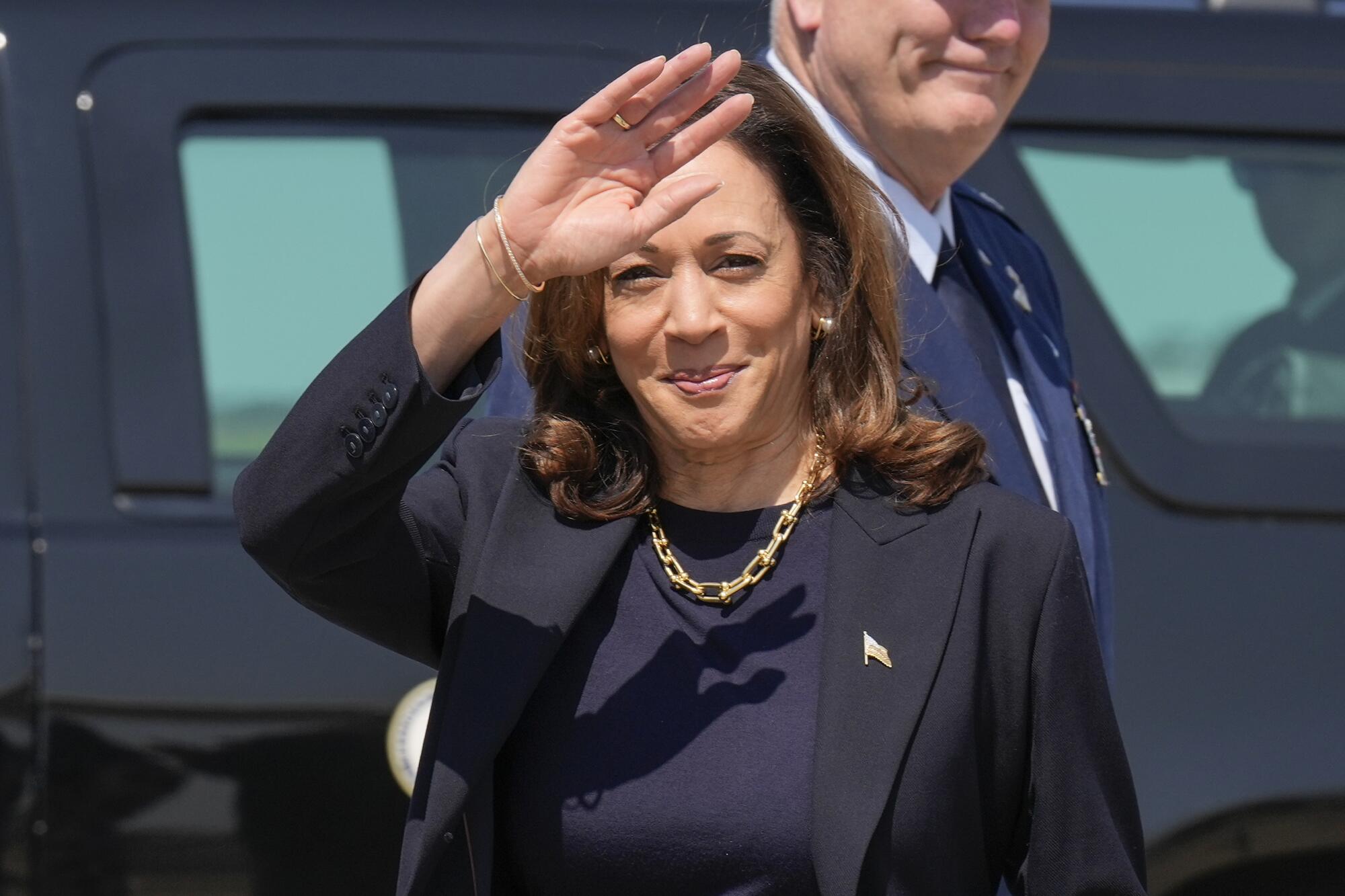
Kamala Harris concedes the election for president.
Kamala didn’t lose race for President because of the economy, failures of campaign or party. Americans must decide if they believe in democracy and are willing to fight for it beginning at home.
It is 6:13 a.m. on Saturday, November 9, four days after Kamala Harris’ stunning defeat by Donald Trump—a twice indicted, convicted felon, serial sexual predator, lover of “strong men” and autocrats, homey of white supremacists and fascist dictators, and mean-spirited and right down nasty hombre. There are worst adjectives to describe him, but what’s the point? Slightly over half this year’s electorate found him acceptable, more so than a former prosecutor, U.S. Senator, incumbent U.S. Vice President, child of Jamaican and South Asian immigrants, and a Black woman, who rose from humble beginnings to achieve a large measure of the American dream.
Ever since the morning after November 5, almost half the electorate who voted for Harris have been trying to understand what happened. Have Americans become so conservative, rightwing or conditioned to the meanness and dishonesty of Trump and his supporters that they are willing to ignore his most egregious behavior and dangerous threats to the rule of law and democratic norms? Many Trump voters didn’t seem to cherish the ideals of the American Republic like we thought they would. No Trump supporter will admit this, but racial solidarity and gender animus seemed to trump all. That is not to say that race and gender are the only reasons Harris lost. But when you take all the other possible reasons, strip them down to their finest points, they don’t hold up. Let’s take for example the argument that the Democratic Party has abandoned the white working class.
If Democrats didn’t abandon the working class, who did?
Before all the votes had been counted, pundits and media commentators took to the airwaves proclaiming that Harris lost because the Democratic Party had abandoned the working class, and at the same time, had become a party of the elite. Even Sen. Bernie Sanders and Rep. Alexandria Ocasio-Cortez did a disservice by perpetuating that same narrative, ignoring that the majority of Blacks and Latinx voters who supported the vice president were working class too. Make no mistake, both parties have not centered the working class as they should have. Going back as far as President Clinton’s campaign—and up to Harris’—the Democrats stopped even using the term “working class,” opting instead to call all workers “middle class.” But the Republicans have been much worse. In fact, Republicans have not only abandoned the working class, they have embraced fascism. Fascism has brought no tangible benefits to workers as far as I can tell. That Republicans won a larger share of working class voters than Democrats seems to suggest that workers were driven to the GOP for reasons other than class interests.
In 1992, democratic political consultant James Carville coined the phrase: “It’s the economy, stupid.” Ever since then political analysts have tended to view all elections as referendums on the economy. Inherent in the criticism of the Harris campaign was that she lost the election because her party had abandoned the working class and the economy was so terrible under her and Biden that voters demanded change. I am supposed to believe that seventy-eight year old Donald Trump with all his baggage represents more change than a 60 year old Black woman who graduated from Howard University?
By the time Harris’ campaign was in full swing, the economy was improving so rapidly that it no longer should have been a liability for her, particularly considering job growth, lowering of unemployment, and the 4-year gains in the stock market. The Chips Act returned many manufacturing jobs to the U.S., and the Biden-Harris Administration invested heavily in the infrastructure which created and saved many working class jobs. The housing construction market is booming and mortgage rates are headed downward. Many people are still hurting from inflation but the Republicans offered no proposals to make the economy better for working Americans. Harris’ campaign proposed to build an opportunity economy that would have helped those with the greatest needs.
Both parties refused to admit that the inequities and contradictions in the economy are structural. They both kept pushing the myth that they could deliver opportunities without deeply reforming capitalism. The needed reforms would have met stiff opposition from Republicans, but they would have had nothing to do with affirmative action (code for Black people), immigration (code for Mexicans and other persons of color), and misplaced priorities of the Democratic Party (code for “Nigger and trans lovers” who care more about “wokism” than white workers who’ve lost their jobs as factories have shuttered in the U.S. and moved to China to exploit cheap labor). Trump only wants to give huge tax breaks to Elon Musk and other billionaires. It defies rational thought that white workers would think that he, who doesn’t support raising the minimum wage to $15 an hour and refuses to pay his employees overtime, cares more about their lives than Harris.
Trump’s strength among women and minorities
Opponents of the thesis that race and gender played major parts in Harris’ loss, will point out that Trump received 13 percent of the Black vote, including 21 percent of Black men, and 46 percent of the Latinx vote, including 55 percent of Latinx men. Those numbers should not detract from the fact that Trump won every category of white voters except college educated white women (and there weren’t enough of them to make a difference). All said, he won 57 percent of all white voters, by far the largest voting bloc at 71 percent of all voters; and 53 percent of white women voters. White women voted their race over their reproductive rights, and they voted their race over their fears or concerns over fascism or the collapse of democracy. There is little need to analyze the motivation of white men; 60 percent of them were all in for Trump. And the bromance we saw on display with Elon Musk, J.D. Vance, Hulk Hogan, Tucker Carlson, Gov. Brian Kemp, and many others was enough to make my skin crawl.
The Black men who supported Trump were noncollege educated, and it appeared that Trump’s projection of machismo coupled with some Black men’s misogynistic attitudes explains why 21 percent of them would support him.
His support among Latinx was a little harder to explain. Trump built his campaign largely on a strategy of denigrating Latino immigrants. He refused to apologize for having a comedian speak at his Madison Square Garden closing event who called Puerto Rico an island of floating “garbage.” Still he received a large share of their vote although their total vote constituted only 12 percent of his total votes received. Maybe the diversity of the Latinx communities in the U.S. best explains our bewilderment. There are many distinct groups of Hispanics who don’t share a common history and culture, even though they speak Spanish, and some identify as white. Some Latinos like Cuban expatriates, who settled in Florida, have a history of identifying with rightwing, antisocialist and anticommunist sentiments. Trump’s efforts to brand Harris as socialist, frequently referring to her as “comrade Kamala,” might have worked in some cases. Republicans have successfully branded the Democratic Party as one that is powered by socialists, Black women and educated elites. Many Hispanics, especially men, don’t want any part of that.
We all know that there are major demographic shifts underway in the United States. Blacks, Latinx and other people of color are becoming the numerical majority. Whites, as a distinct racial group, will no longer have the advantages in numbers they enjoy today. Trump has ratcheted up fear among whites of being in the minority, so much so that this anxiety is driving them to become hostile to minorities, immigrants, and anyone else who isn’t white, straight, Christian, and Anglo-Saxon. The Great Replacement Theory is but one example of the conspiracy theories that have been normalized under Trump.
For sure, all whites aren’t Republicans, and they don’t all fear being replaced by minorities, but the exit polls show that too many did—and this had a lot to do with the outcome of the election. But the election outcome, as predicted by poll after poll, was very close and did not signal a major shift in the U.S. body politic. By a slim margin, the MAGA voices won out, but we should acknowledge just how close the yeas and nays actually were, with Trump winning a little more that 75 million votes (just a tad above the 74.2 million he received in 2020 in a losing cause) or 50.4 percent of the 2024 total vote. The MAGA numbers didn’t expand much beyond 2020, but the heartache that many of us experienced after the results came in was over the lost opportunity for making history and turning the page on Trumpism.
What can be done?
We must steel ourselves for four more years of Trump who is bound to be more unhinged and dangerous than before. We need to unite and remain ready to fight every move he makes toward authoritarianism. Let’s remember Trump is but a vehicle through which many ideologies get expressed. He is a mirror of our society, and when we look at him we see the ugly underbelly of America. We don’t like what we see, and many of us would like to see change, but first we must admit that the U.S. is racist, sexist, and class-biased. Then let’s have a reckoning about who we want to be.
This will be a tall order because many Trump supporters are so vested in the MAGA version of reality that they could never bring themselves to admit that the America they want to return to is an America that most of them never experienced and never will. It is also an America that excluded me and most people who look like me. If we still, or ever, believed in a multi-racial, multicultural democracy then we must fight to achieve it—notwithstanding what Sen. Tim Scott and Amb. Nikki Haley said about America not being a racist country. The overwhelming number of Black people know the deal: Be twice as good as whites (Harris was four times better than Trump), keep your hands on the steering wheel when stopped by cops, and dance freely to the beat of music and not to the screaming guitars.
Our white brothers and sisters must take the lead in cracking open this age-old racist thing in their families and culture. And the sad thing about it, this round they must do it alone. I have given up on trying to prevent white people from fearing me. And I can’t make them respect and love me. Whites who care about the ideals of democracy must live out the tenets of their faiths—be born again. I have heard enough white folks describe their parents as MAGA supporters, but say they avoid discussing Trump with them because they desire to maintain a positive relationship with them. I am tired of hearing white women tell me that their parents raised them to see no color, but they better not bring home a Black boyfriend.
Democrats have not left behind white workers in their pursuit to win over highly educated Black women like Kamala Harris who easily could have been rotting out in a prison cell built for her kind when she was in the third grade. She could be bleeding out today in a hospital parking lot because no one will treat her for fear of being prosecuted. No, brothers Sanders and Carville, it is not the economy—Stupid.
It is Racism—Stupid!

 Jabari Simama Speaks
An Excellent and Enlightening Article, Which Should Be Published in the AJC and Other News Media!!!
LikeLike
Good analysis, with which I agree. Pundits seem to falling all over themselves to provide explanations other than the obvious.
LikeLike
The Black grassroots’ communities of the mid-20th century, so important a force for change, have been ignored, abandoned by their natural allies in the Black elite class, haven’t profited from and satisfied by the gains made. It’s not musing over a nostalgic fixation, but a reality of an agency not give given due credit and one still able and a fit partner in a multidimensional process for change. Let’s rethink this possibility.
LikeLike